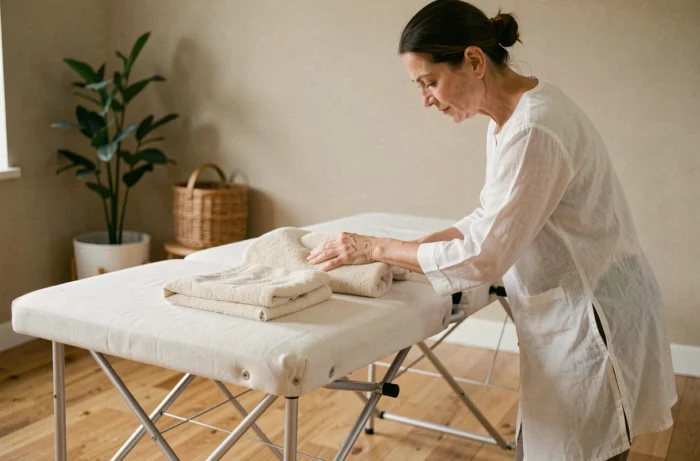
Installing a massage table at home presents a concrete problem from the start: the available space dictates almost everything else. Between a clear living room and a narrow guest room, you wouldn’t choose the same model, width, or leg system. Choosing the right massage table for home use starts with the room where it will be used, not from a catalog.
Thickness and foam density: what truly determines the comfort of a massage table
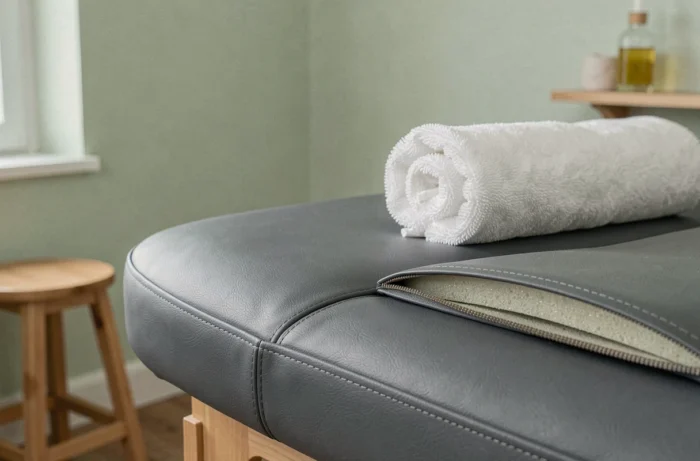
Competitors often talk a lot about structure, weight, and dimensions. Few detail what matters most for the person lying down: the mattress. During a one-hour session at home, a padding that is too thin or too soft turns the massage into discomfort.
The density of the foam determines the support. Low-density foam compresses within a few months of regular use. Conversely, high-density foam supports the body without creating pressure points. For home use with frequent sessions, prioritizing dense foam over thick but soft padding makes all the difference in the mattress’s lifespan.
Thickness plays a complementary role. Below a certain threshold, even good-density foam is not enough to absorb the pressure from the practitioner. You can regularly find on latable-de-massage.fr product sheets that detail these technical characteristics, which helps in comparing before purchasing.
The covering also matters. PU (polyurethane) dominates the market for folding tables. It resists massage oils and is easy to clean. PVC, cheaper, tends to crack after a few months if vegetable oils are not wiped off quickly.
Folding or fixed massage table at home: a choice dictated by the room
At home, the question arises differently than in a practice. A practitioner who travels to their clients needs a lightweight folding table. Someone who dedicates a fixed space at home can opt for a stationary model, which is more stable and often wider.
When a folding table is necessary
If the table needs to be stored between sessions, the folding option is the only realistic choice. It can be slipped behind a piece of furniture or into a closet. Weight then becomes a sorting criterion: some aluminum models weigh significantly less than wooden models, making repeated handling easier.
An aluminum folding table is better suited for frequent moves within the home. Wood (often beech or maple), on the other hand, offers better stability once unfolded and absorbs vibrations better during the massage.
When a fixed model makes sense
In a dedicated room (converted office, finished basement), a fixed table provides superior comfort. The width can be more generous without folding constraints, and the structure does not move. Some fixed models include hydraulic height adjustment, which avoids manual adjustments between two people of different sizes.
Table height and the masseur’s posture: the underestimated parameter
People often think about the comfort of the person being massaged. But at home, it is often a relative who massages, not a professional used to working for hours on their feet. An incorrect table height fatigues the back and shoulders of the masseur in less than twenty minutes.
The ground rule is simple: standing, arms at the sides, the tabletop should reach wrist level. Too high, and you compensate by raising your shoulders. Too low, and you bend over, straining your back.
Tables with height adjustment via telescopic legs allow for position adaptation according to the person who is massaging. This is a clear advantage at home, where several household members may use the table. Feedback varies on this point depending on the mechanisms: push-button systems are quick but sometimes less precise than screw systems.
Budget and durability of a massage table for home use
Recent buying guides suggest a recommended budget for a durable home massage table between a few hundred euros for serious entry-level models and a significantly higher tier for semi-professional ones. Very cheap models pose a real problem: deformation of the tabletop and instability within a few months of regular use.
What we observe in practice is that the first misplaced economy is the foam. A solid structure with mediocre padding forces you to buy or replace the cushioning quickly. Conversely, good foam on a decent structure lasts several years without notable loss of comfort.
Here are a few points to check before purchasing:
- The manufacturer’s warranty on the structure (frame and legs), which reflects the manufacturer’s confidence in their materials
- The maximum load supported, which should cover the weight of the person being massaged plus the pressure exerted by the practitioner
- The availability of spare parts (tension cables, replacement foams, headrests) to avoid having to buy an entirely new table in case of localized wear
One last often-forgotten point: at home, a massage table is not subject to the same fire reaction regulatory requirements as in establishments open to the public. No specific fire rating is required for private use, unlike spas or wellness centers where a minimum rating is mandatory. This broadens the choice of coverings and foams available for individuals.
The choice of a massage table for home use comes down to three concrete trade-offs: foam (density before thickness), format (folding if space is tight, fixed if a room is dedicated), and adjustable height to protect the back of the person massaging. Everything else, color, accessories, design, comes after these fundamentals.