
A workstation lagging due to a misconfigured AI agent, a firewall bypassed by a simple stolen session cookie, a skyrocketing cloud bill because no one anticipated the consumption of language models: real-world problems are changing in nature. This year’s IT trends and innovations are not just marketing announcements. They directly alter how we manage, secure, and budget our environments.
Authentication Token Theft: The Threat Replacing Passwords
We protect accounts with MFA, we tighten password policies, and yet compromises continue. The problem lies elsewhere. Since the beginning of the year, several cybersecurity players (Sekoia, Microsoft) have observed a massive shift towards authentication token theft: OAuth tokens, session cookies, temporary access tokens.
Specifically, an attacker who intercepts a valid token no longer needs the password or the second factor. They connect directly to the target’s cloud environment or Microsoft 365. The FBI reported in May 2026 the rise of a Phishing-as-a-Service platform named Kali365, specialized in this type of theft from Microsoft 365 accounts.
To follow IT news on Geek Newz allows you to keep an eye on such alerts without waiting for official bulletins.
What this changes on the ground:
- Password rotation policies become secondary compared to hardening token lifetimes and monitoring abnormal logins.
- Conditional access (geolocation, browser fingerprinting, workstation compliance) shifts from a recommendation to an operational necessity.
- Security teams must train users not only on classic phishing but also on fraudulent OAuth consent pages, a much less recognized vector.
AI in Business: The Real Cost of Field Deployment
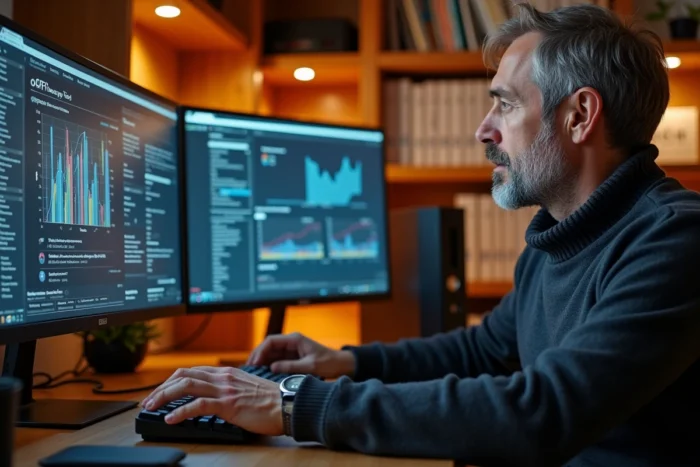
Most presentations on AI in business stop at demonstration. In the field, the first obstacle is neither technical nor cultural: it’s the bill. Each call to a language model consumes computing resources, and the GPU consumption of an internal AI assistant can exceed that of dozens of standard workstations.
When integrating an AI agent into a workflow (customer support, ticket sorting, report generation), three expense items need to be anticipated that vendors rarely mention: the inference cost per request, the storage of conversation contexts, and the bandwidth between the model and internal systems.
Governance and GDPR Compliance of Models
The CNIL and several European authorities have strengthened their oversight on the use of AI models processing personal data. Anthropic (publisher of Claude) is, for example, subject to documented GDPR compliance analyses. Any deployment of an LLM on internal data requires an impact assessment (AIPD) before going into production.
Feedback on this point varies depending on the size of the organization: a small business of fifty people does not have the same documentation obligations as a publicly traded group. The challenge remains the same: to trace what data passes through the model, where it is stored, and who has access to it.
Digital Sovereignty and Cloud: What’s Changing on the Infrastructure Side
Bercy recently disconnected the testing of a Chinese LLM on a public infrastructure. This type of decision illustrates a broader movement: the issue of sovereignty no longer concerns just data, but the models themselves. Hosting data in France is not enough if the inference engine depends on a vendor subject to extra-European jurisdiction.
Several points deserve the attention of companies that want to maintain control over their processing chain:
- Favor open-source, auditable models over opaque proprietary APIs, even if raw performance is slightly lower.
- Ensure that the cloud host contractually guarantees the absence of transfer outside the EU, including for AI request logs.
- Map the actual dependency on each provider: a change in pricing policy or terms of use can render a project unviable in a matter of weeks.

Chip Architecture and Post-Silicon Computing: Concrete Signals
IBM has unveiled a 0.7 nm chip architecture. At this scale, we are approaching the physical limits of the classical transistor. This is not a laboratory curiosity: each gain in etching fineness translates into a reduction in energy consumption per operation, a direct parameter for the data centers powering AI workloads.
Meanwhile, photonic computing (which uses light instead of electricity to transfer information) and neuromorphic computing (architectures inspired by the brain) are advancing. These approaches will not replace classical processors in the short term, but they are beginning to appear in targeted use cases: network routing optimization, molecular simulation, real-time video stream processing.
Energy Consumption of Data Centers
The growth of the data center market is accelerating, driven by AI demand. Energy-efficient computing is no longer a marketing argument but an operational constraint. New liquid cooling architectures and very low etching chips contribute to the same goal: to maintain computing capacity without skyrocketing the electricity bill.
The subject remains technical, but it directly impacts the IT budgets of any organization consuming cloud services. Monitoring the evolution of hardware architectures helps anticipate reductions in inference costs and plan infrastructure renewals at the right time.