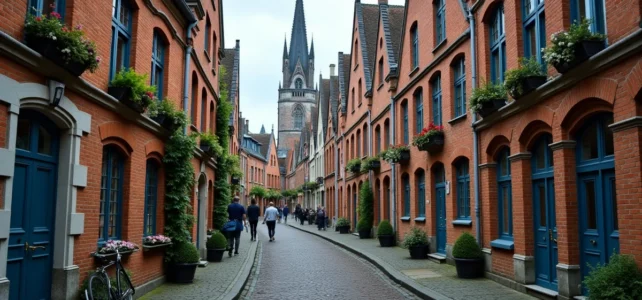
The red brick facades lined along a cobblestone street, the stepped gables cutting into the gray sky, an interior where linen meets raw stone: Northern France and Flanders carry an architectural and decorative vocabulary unlike anything else in Europe. This built heritage tells the story of centuries of trade, harsh climate, and a taste for discreet comfort.
Brick, stepped gable, and roofing: reading a Flemish facade
Have you ever noticed that some houses in the North seem to have a stepped design at their top? This pattern, the stepped gable (also known as a crow-stepped gable), is not purely decorative. It allowed masons to access the roof without scaffolding and reduced wind resistance in a region swept by gusts from the North Sea.
Brick, omnipresent, can be explained by the local geology. The clay subsoil provided the raw material at hand, where cut stone had to be imported at great expense. The red, yellow, or orange bricks vary from one city to another depending on the clay composition and firing temperature.
To delve deeper into Flemish architecture and decoration, one must also observe the window frames, often highlighted by white stone or sandstone, creating a graphic contrast with the surrounding brick. This play of colors was not an aesthetic whim: it once signaled the prosperity of the owner.
Raw materials and linen: the Flemish interior style as an international reference
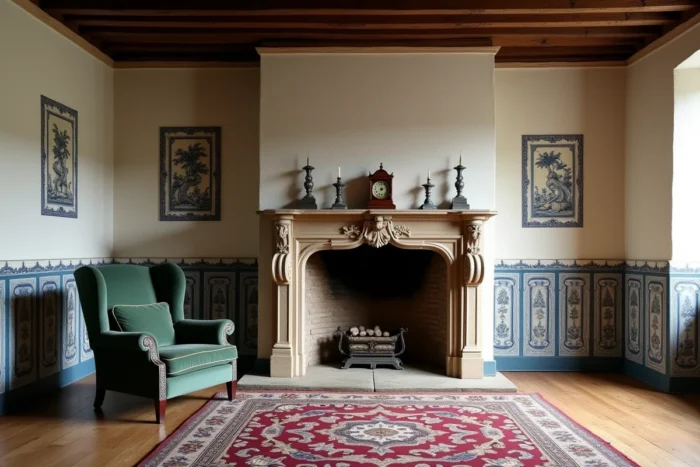
Contemporary Flemish decoration does not seek accumulation. It rests on a simple principle: let the materials speak rather than the ornaments. Raw wood, textured plaster, ancient stone flooring, natural linen textiles. The result creates a warm atmosphere without visual overload.
High-end decoration magazines now recognize the specificity of this style, particularly rooted in Belgian Flanders. It stands apart from Mediterranean or Scandinavian traditions by its material density: the surfaces are rough, patinated, alive.
- Linen, historically cultivated in the region, adorns curtains, tablecloths, and cushions with a matte texture that absorbs light rather than reflecting it.
- Exposed beams, often made of oak, remain untreated or simply oiled to preserve their original grain.
- Blue stone floors from Hainaut or old tiles bring a visual freshness that modern parquet cannot replicate.
This decorative vocabulary is cited internationally as a reference for chic and refined country interiors. The Flemish style embodies discreet comfort, balancing between embraced rusticity and sober refinement.
Heritage renovation in rural Flanders: conserve rather than recreate
In the Flemish countryside, a recent approach to renovation is gaining traction. Instead of transforming an old farmhouse into a contemporary loft or imposing a “traditional” frozen decor, owners are opting for minimalist restoration.
The principle: preserve the historical texture of walls, floors, and frameworks, then integrate modern amenities (insulation, heating, home automation) invisibly. An electrical conduit runs behind a beam, a floor heating system disappears beneath the original tiles.

This logic of material sobriety opposes the temptation of pastiche. Painting beams in anthracite gray to “make it modern” or laying brick-effect tiles would erase what gives value to the built environment. Flemish brick ages well. Its irregularities, its color nuances after decades of exposure to the elements are precisely what heritage enthusiasts seek.
What distinguishes this approach from a classic renovation
The goal is not to return the house to its original state, but to find a balance between contemporary comfort and the authenticity of materials. One does not recreate an 18th-century interior. One inhabits an old building with today’s requirements, respecting what the walls tell.
Belfries, Old Stock Exchange, colorful facades: urban Flemish heritage in Lille
Lille concentrates several centuries of Flemish architecture within a few square kilometers. The Old Stock Exchange, built in the 17th century, remains the most photographed symbol of this influence. Its sculpted caryatids, columns, and inner courtyard illustrate the commercial prosperity of the time.
The belfry of the Town Hall, on the other hand, belongs to a completely different register. Its Art Deco style contrasts with the surrounding red bricks. It testifies to Lille’s ability to blend Flemish and modernist heritages without apparent contradiction.
The facades of Old Lille deserve careful attention. Each street aligns variations in color, height, and decorative relief (the small decorative brick or stone reliefs). Some display sculpted cartouches indicating the owner’s trade or the date of construction.
- Red brick dominates in the oldest neighborhoods, while yellow brick appears in 19th-century constructions.
- The pedimented dormers, typical of bourgeois houses, recall the influence of the Spanish Netherlands.
- The inner courtyards, often invisible from the street, once housed workshops and warehouses related to the textile trade.
Flemish decoration in everyday life: adapting the style without freezing it
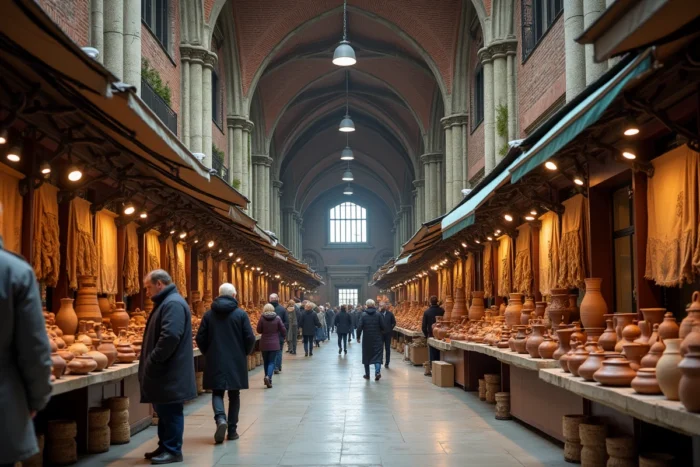
Reproducing a Flemish ambiance at home does not require living in a gabled house. A few material choices are enough to recapture that characteristic warmth.
Favoring textiles made from natural fibers (linen, thick wool) rather than synthetic fabrics immediately changes the perception of a room. Unbleached linen captures light differently depending on the time of day, creating a shifting atmosphere without artifice.
Walls benefit from remaining imperfect. A slightly irregular lime plaster, a brick left exposed on a wall, simply oiled wood: these lively surfaces contrast with the smooth and uniform finishes that dominate standardized decoration.
Traditional Flemish furniture favored dark woods and massive shapes. Without falling into literal reproduction, choosing a raw oak table or a generously proportioned sideboard effortlessly anchors a room in this lineage without the need for staging.
The architecture and decoration of Northern France carry an identity that neither climate nor trends have managed to dilute. Brick ages, linen creases, beams settle: it is precisely this patina of time that gives value to the Flemish style.