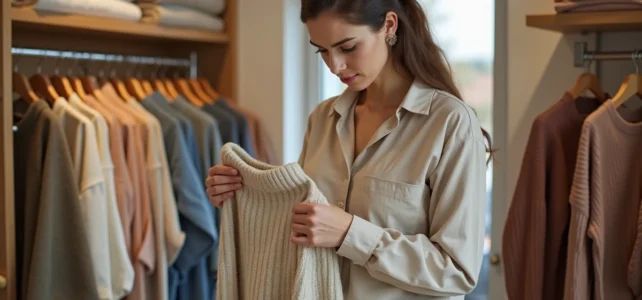
Buying clothing online or in-store without being able to assess its durability, actual fit, or the reliability of its labeling remains a gamble. Brands that position themselves in an accessible segment, like Sonstiges, multiply references and ranges, making sorting even more complicated.
The European regulatory framework is evolving towards greater transparency, particularly with the digital product passport and environmental labeling for textiles currently being deployed. In this context, a few concrete reflexes can help limit disappointments.
Composition and weight of materials: what the Sonstiges label doesn’t always say
The product sheet of a Sonstiges garment indicates the textile composition but rarely the weight of the fabric. A lightweight cotton t-shirt will not react to washing in the same way as a denser model. Before ordering, feeling the fabric in-store or looking for real-world feedback on the actual thickness of the textile can prevent initial disappointment.
Synthetic blends (polyester, elastane) present in many pieces of the range pose another problem. They facilitate maintenance and shape retention, but synthetic materials often age less well than cotton or linen over time, especially in terms of pilling. Real-world feedback varies on this point depending on the collections, making generalization difficult.
For those who want to discover the Sonstiges brand on Have a Fashion Break, a detailed buying guide allows for comparing pieces before making a decision.
The European regulation on PFAS (per- and polyfluoroalkyl substances) also concerns textiles. Checking that the brand communicates about the absence of controversial chemical treatments in its finishes becomes a relevant reflex, even for moderately priced clothing.

Size and fit of Sonstiges: why size guides are not enough
Online size guides provide generic correspondences (chest circumference, waist circumference, length). At Sonstiges, as with most brands positioned in the accessible segment, the same size can vary from one cut to another within the same collection. A straight-cut dress in size M will not fall like a fitted model in size M.
The available data does not allow us to conclude that a systematic sizing issue exists at Sonstiges. However, several points deserve verification before purchase:
- Compare your own measurements (taken flat, with a tape measure) to the dimensions indicated on the product sheet, rather than to the usual sizes worn at other brands
- Check if the brand specifies the measurements of the garment itself (total length, width at the armpits) in addition to standard size correspondences
- Consult customer reviews that explicitly mention the buyer’s morphology, to spot recurring discrepancies between ordered size and received size
For shoes, the Sonstiges size may differ from one model to another. Measuring the length of your foot in centimeters is more reliable than relying on your usual shoe size.
Sonstiges value for money: where the limit of accessible design lies
The pricing position of Sonstiges attracts a clientele looking for varied designs without investing in high-end products. The question is not whether these clothes are worth their price (the value for money is subjective), but identifying the pieces that last over time and those that are consumable.
Basic pieces (solid color t-shirts, straight pants) generally offer a better return on investment than pieces with strong designs, which are worn less often. A well-cut basic pays off, while a poorly finished standout piece ends up in the closet.
Spotting finishes that betray a fragile garment
A few concrete checkpoints allow for sorting before purchase or upon receipt:
- The seams of the armholes and the crotch should be double or reinforced, as these are areas of maximum tension on a garment worn daily
- Buttons sewn with a single thread (without a textile shank) will pop off after a few washes
- A glued hem (fusible) rather than a sewn one often comes undone after a few washes
- On both men’s and women’s pieces, check that the topstitching is even and without pulled threads

Environmental labeling and digital passport: what changes for the consumer
The French framework is moving towards an environmental score displayed on clothing, aimed at comparing the ecological impact of textile products beyond just price. This system, still being finalized, could change the way brands like Sonstiges communicate about their ranges.
The digital product passport (DPP), integrated into the European ESPR regulation, will gradually make structured data on the life cycle of the garment mandatory. This information will be accessible via QR code, NFC, or RFID directly on the label. For the consumer, this means that eventually, scanning a Sonstiges label in-store will provide access to the traceability of materials, manufacturing conditions, and the estimated carbon footprint of the product.
The available data does not yet indicate when Sonstiges will integrate this system into its collections. The absence of any environmental information on a textile product sheet becomes a warning signal in a context where transparency obligations are strengthening across the sector.
Choosing a Sonstiges garment without unpleasant surprises ultimately relies on three concrete checks: the actual composition and weight of the fabric, the measured size correspondence (not guessed), and the condition of the finishes at tension points. The rest, the design, fit, color, is a matter of personal taste, an area where no one can go wrong on your behalf.