
The used motorcycle market is full of machines showing several tens of thousands of kilometers. On sales platforms, the 40,000 km mark on the odometer often causes hesitation among buyers, especially if they are beginners. Mileage remains an almost automatic sorting criterion, sometimes to the detriment of much more revealing information about the actual condition of a motorcycle.
Technical inspection for motorcycles and mileage: what has changed since 2024
The gradual introduction of the technical inspection for motorcycles in France starting in 2024 has reshuffled the cards for high-mileage used motorcycles. Before this requirement, the buyer had only the seller’s word and their own visual inspection to assess the vehicle’s condition. Now, an official report documents the state of the motorcycle at the time of sale.
A motorcycle with 40,000 km that has a clean technical inspection or only minor failures offers an unprecedented guarantee. This document does not cover everything: internal engine wear or the actual age of the tires are not among the checked points.
As highlighted by a motorcycle buying guide published by Touring, the technical inspection focuses on safety and environmental standards, not on consumables or crash damage.
To delve into whether 40,000 km for a motorcycle according to WD Car represents truly problematic mileage, one must look beyond the simple displayed number and see what the documents reveal.
Since June 1, 2026, an additional evolution deserves to be noted: all manufacturer recalls are now listed on the technical inspection report. For a motorcycle that has been heavily used, this allows verification of whether recall campaigns (braking, steering, structural components) have been resolved or not. An unresolved “stop drive” recall even results in a classification as a critical failure, preventing the sale in its current state.

40,000 km on a motorcycle: compare what is comparable
Reasoning in absolute mileage does not make much sense without considering the type of motorcycle, its engine size, and its usage. Wear thresholds vary significantly from one category to another.
A large-displacement trail bike (BMW GS, Honda Africa Twin) designed for covering distances is in a perfectly normal phase of life at 40,000 km. The engine, transmission, and chassis are sized for this type of use. In contrast, the same mileage on a sportbike like a Honda CBR 600 or a Suzuki GSX-R indicates intensive use, with often high engine speeds and greater mechanical stress.
The average annual mileage for a motorcyclist is around 5,000 km, according to market data published by Touring. A motorcycle with 40,000 km therefore has between eight and ten years of “normal” use behind it, which is not alarming.
Factors that matter more than the raw number:
- The type of kilometers traveled: highway and national roads wear the engine less than city driving, where acceleration and braking cycles are constant and engine temperature fluctuates more
- The regularity of maintenance, documented by a service book or invoices: oil changes, chain and sprocket replacements, brake fluid, coolant
- The number of owners and the consistency between mileage and the age of the motorcycle (a three-year-old vehicle with 40,000 km has been used intensively, which is not necessarily a flaw if maintenance has been followed)
Real warning signs on a high-mileage used motorcycle
Mileage does not reveal what is happening under the bodywork. However, some signs are unmistakable, regardless of the number of kilometers displayed.
The front fork is a reliable indicator of overall condition. Oil traces on the stanchions indicate worn seals, a repair that can cost several hundred euros depending on the model. On a motorcycle with 40,000 km, this wear is plausible if the seals have never been replaced.
The brakes deserve a thorough inspection. The thickness of the pads can be checked visually, but the condition of the discs (warping, deep grooves) requires a more careful examination. A dark brake fluid or fluid that has never been bled poses a direct safety risk.
The steering column often reveals a history that the seller would prefer to keep quiet. Stutters or a hard spot when turning the handlebars while stationary, with the engine off, betray damaged steering bearings, sometimes resulting from a fall.
The behavior of the engine when cold remains a test that is difficult to simulate. A laborious start, stuttering at idle, or persistent bluish smoke from the exhaust point to internal wear (piston rings, valve guides) that mileage alone cannot reveal.
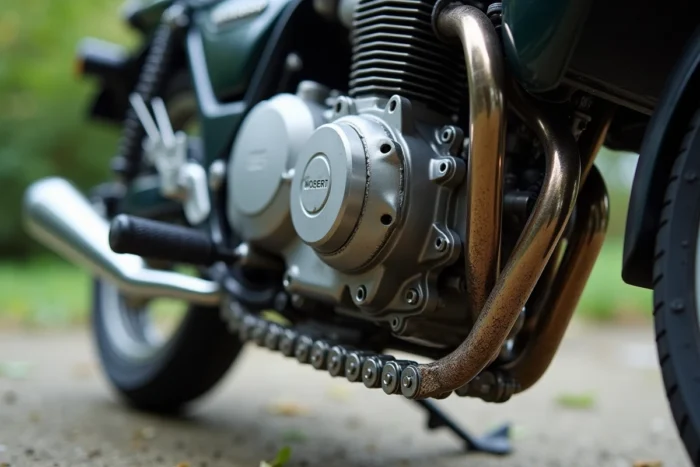
Negotiation and depreciation: mileage as a lever, not as a verdict
In the used market, 40,000 km significantly lowers the price compared to a comparable motorcycle with half the kilometers. This depreciation works in favor of the informed buyer who can distinguish a well-maintained motorcycle from a neglected one.
A complete maintenance book with invoices from a dealer or identifiable mechanic changes the game. Brands like Honda, Triumph, or BMW have networks that archive the history of interventions, allowing cross-referencing of the seller’s statements.
Field feedback varies on this point: some motorcyclists believe that a motorcycle over 50,000 km enters a zone where repair costs can exceed the savings made at purchase. Others ride without major issues well beyond 100,000 km on models known for their mechanical reliability. The difference almost always comes down to the quality of past maintenance and the type of engine.
The technical inspection report, the maintenance book, and a careful road test form a triangle of evaluation that is much more reliable than the odometer. A properly maintained motorcycle with 40,000 km, with a technical inspection free of major failures and up-to-date consumables, remains a rational purchase, often safer than a machine with 15,000 km whose history cannot be traced.