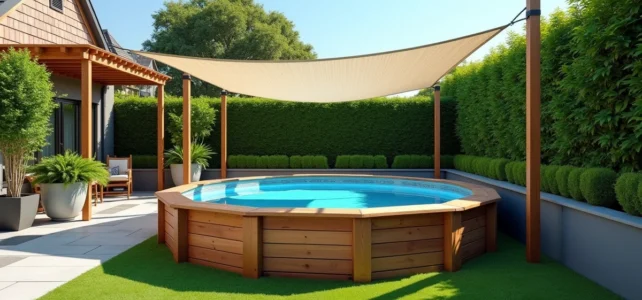
An above-ground pool, whether tubular or self-supporting, perfectly fulfills its function as a refreshing basin. Its weak point remains aesthetics: visible PVC walls, exposed metal tubes, and a liner that contrasts with the rest of the garden. Dressing the perimeter of your above-ground pool helps correct this visual mismatch while protecting the structure from UV rays, which degrade plastic over the seasons.
The following ten techniques cover various materials, budgets, and levels of difficulty. Each adapts to a type of pool and a different garden style. To explore other ideas, you will find above-ground pool dressing ideas on Les Bricoleries de Nanie that complement this selection well.
1. Composite Wood Cladding on Framework
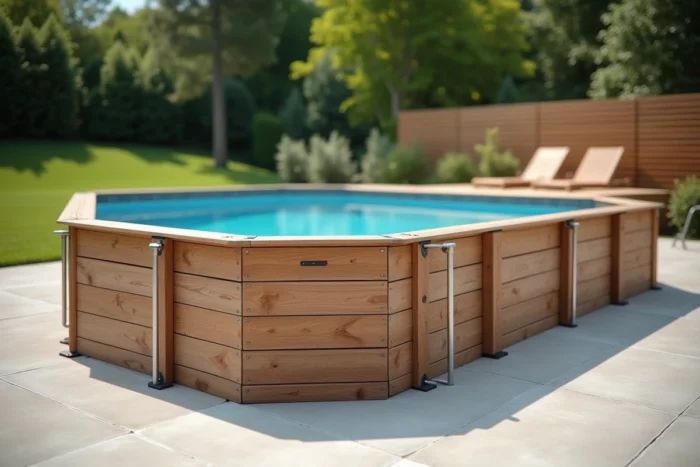
Composite wood combines the appearance of natural wood with superior resistance to moisture and fungi. Unlike treated pine, it requires neither annual staining nor saturating.
The installation relies on a framework of battens fixed to the ground or weighted down, onto which the slats are clipped horizontally. This system allows for the cladding to be dismantled at the end of the season if the pool is stored in winter. Prefer slats whose color is close to your existing deck to create visual continuity.
2. Natural Bamboo Screening Rolled Around the Pool
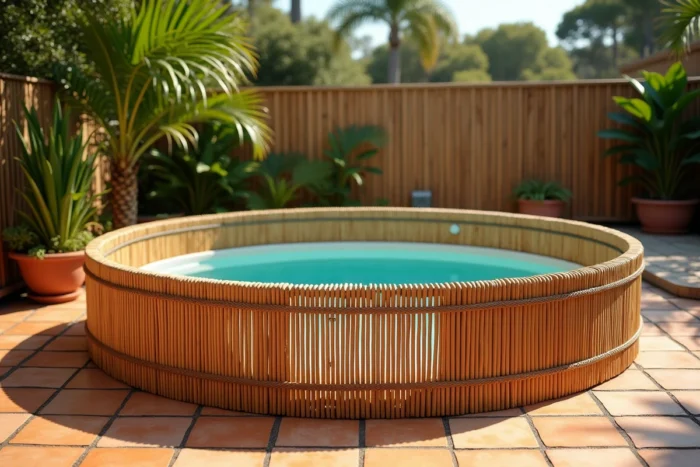
Bamboo screening remains the quickest solution to implement. A roll is fixed directly onto the tubular supports using zip ties or plastic-coated wire.
The result is immediate and the cost very accessible. The main limitation is durability: exposed to the elements, bamboo can gray within one or two seasons. A treatment with linseed oil extends its lifespan. For a denser effect, double the screening with a privacy screen behind it.
3. Rattan Effect Woven Resin Panel
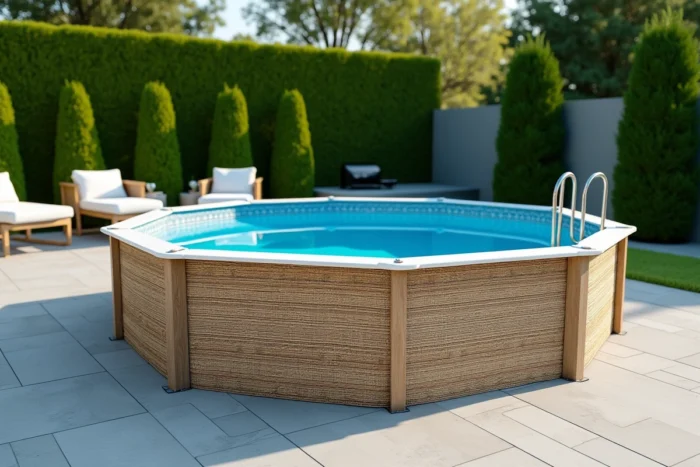
Woven resin panels replicate the look of rattan without fear of water or UV rays. They are sold in rectangular modules that interlock or screw onto a lightweight frame.
This material is particularly suitable for gardens where outdoor lounge furniture is already made of woven resin: the whole creates a cohesive atmosphere. Cleaning is done with a water jet. The only downside is that the rigidity of the panels does not adapt well to round pools, where flexible screening remains preferable.
4. Elevated Wooden Deck with Beach Access
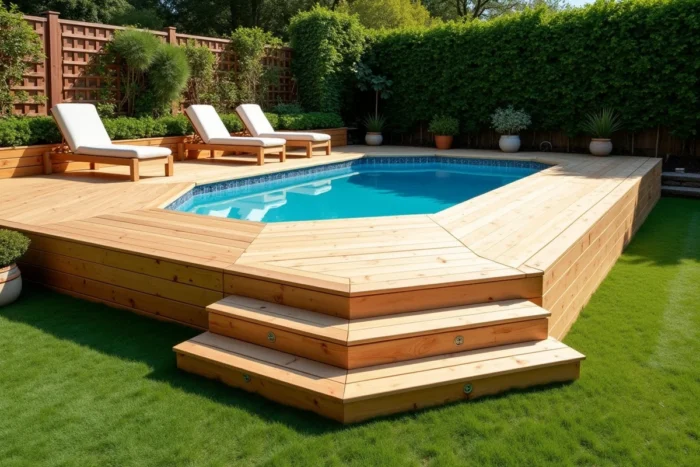
Building an elevated deck at the level of the coping radically transforms the appearance of an above-ground pool. The pool appears semi-inground, and the space around becomes a real relaxation area with sun loungers or a garden lounge.
This type of setup requires a solid supporting structure (concrete blocks, joists, class 4 pine flooring, or composite). The project typically takes a weekend for an experienced DIYer. Be sure to plan for an access hatch to reach the filter and connections without dismantling the deck.
5. Tall Planters with Vegetation Around the Perimeter
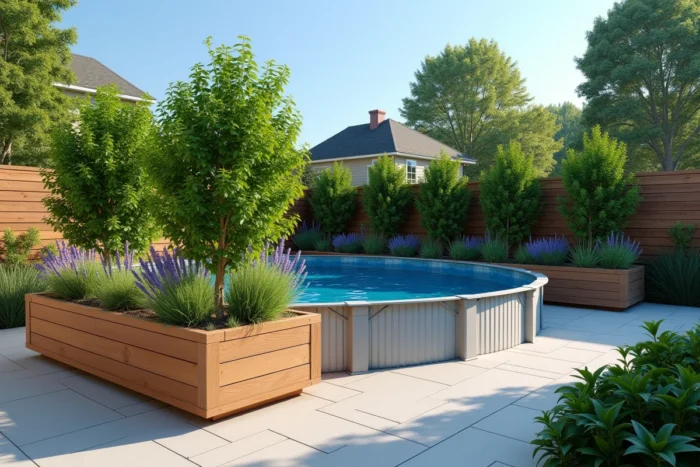
Placing wooden, metal, or fiber planters around the pool creates a green screen that masks the walls while adding color. Ornamental grasses, lavenders, or agapanthus work well in full sun.
The advantage over plants in the ground is that you control the distance between the roots and the liner, and you can move the containers if the pool changes location. Ensure that the height of the planters covers at least two-thirds of the wall for a truly concealing effect.
6. Wooden Trellis with Climbing Plants
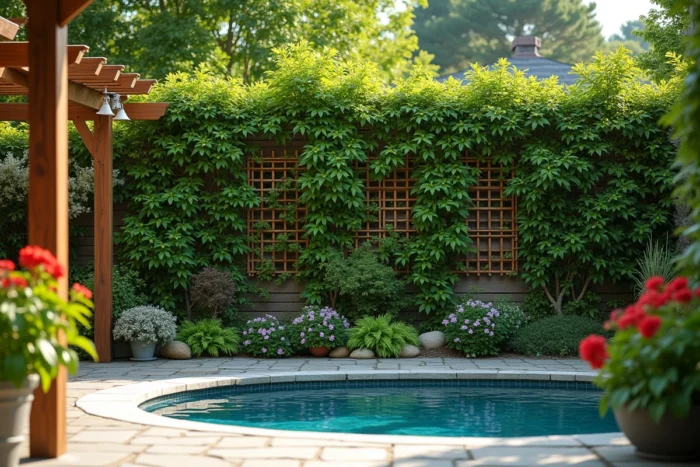
A trellis fixed on posts planted a few centimeters from the wall serves as a support for climbing plants (star jasmine, honeysuckle, passionflower). In one growing season, the foliage covers the trellis and completely hides the pool.
This option produces a very landscaped result, but it requires patience and regular watering in the first year. Keep a ventilation space between the trellis and the PVC to avoid moisture buildup against the wall.
7. Clip-On Reconstituted Stone Cladding
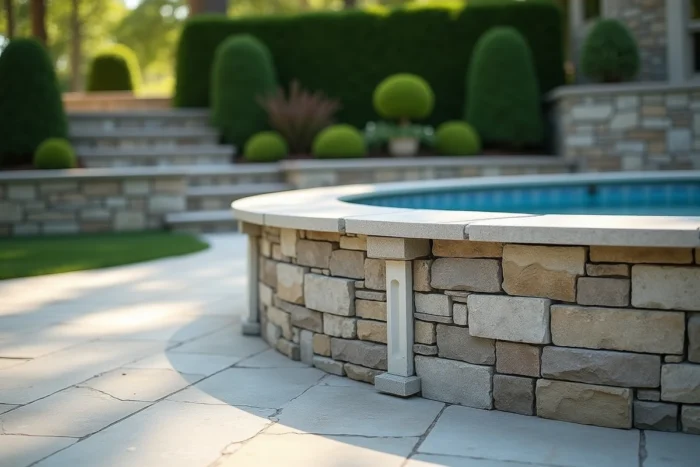
Reconstituted stone cladding tiles glued onto a rigid support (waterproof OSB panel or hollow PVC) provide a high-end mineral look. The result mimics dry stone or Provençal walls.
The weight remains moderate due to the thinness of the tiles. Fixing is done with polymer glue suitable for outdoor use. This solution is suitable for pools that remain in place all year round, as dismantling is less straightforward than with clip-on cladding.
8. Shade Sail and Pergola Adjacent to the Pool
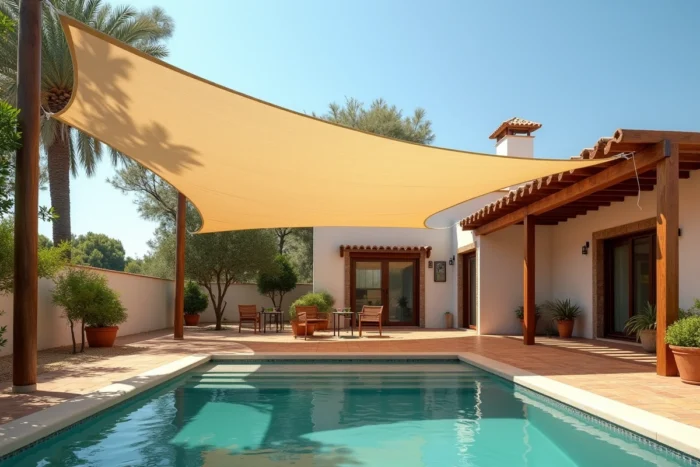
Dressing is not limited to the walls. A triangular shade sail or a lightweight aluminum pergola installed above the pool structures the space and gives it a distinct relaxation area identity.
The sail filters UV rays, reduces water evaporation, and limits leaf fall into the pool. Secure it to masts anchored in the ground or to a nearby wall, never to the pool structure itself, which would not withstand the tension.
9. Synthetic Grass Laid Around the Perimeter
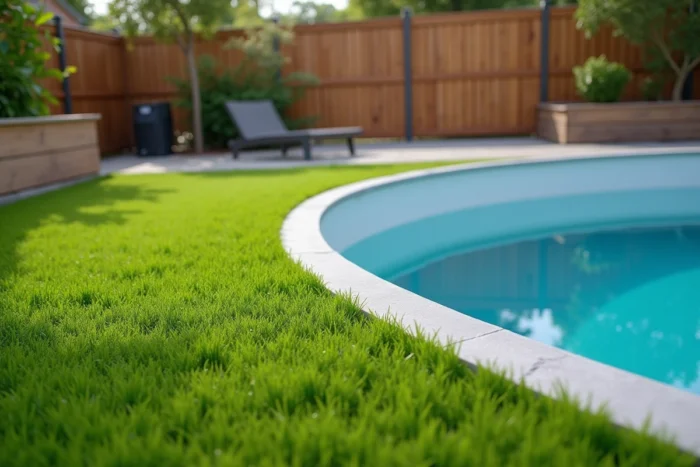
A synthetic grass mat cut to the shape of the pool creates a soft and clean beach around the pool. It prevents mud on rainy days and remains pleasant under bare feet, provided you choose a sufficiently dense weight.
Lay it on a geotextile to slow down weed regrowth. Synthetic grass does not mask the walls, but it transforms the ground space into a true landscaped corner, especially when combined with cladding or planters around the perimeter.
10. Printed Privacy Screen with Wood or Plant Pattern
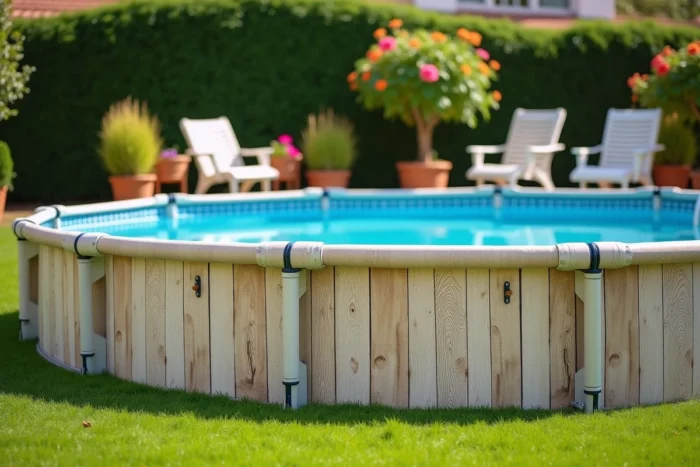
Printed privacy screens mimic wood, laurel hedges, or stone walls. They are fixed with eyelets on the pool tubes and can be removed in a few minutes.
The budget is the lowest of all the options listed here, and the choice of patterns has significantly expanded in recent years, with high-definition prints that deceive the eye from a few meters away. However, the fabric wears out faster than rigid materials: plan for a replacement every two or three summers depending on exposure.
Each technique presented meets different budgets, DIY levels, and garden styles. Removable solutions (screening, privacy screens, woven resin) are suitable for pools stored in winter, while elevated decks or stone cladding are aimed at pools installed year-round. The most effective choice often consists of combining two approaches, such as composite cladding on visible walls and synthetic grass on the ground, to achieve a coherent layout without multiplying projects.