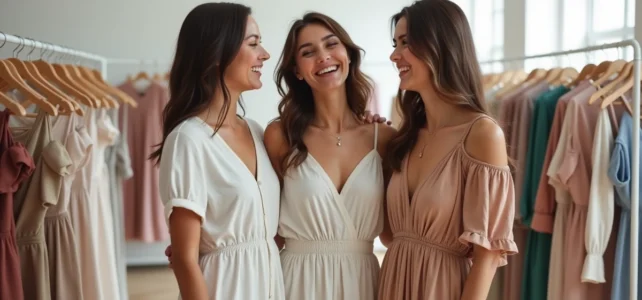
Between the anti-fast fashion law adopted in July 2026 (penalties of up to €20 per item by 2030 on certain articles) and the rise of capsule wardrobes, the choice of each garment weighs more heavily than before. The dress, a unique piece that replaces a top and bottom set, deserves a factual examination: what do we actually gain by making space for it in our closet?
1. Linen or certified cotton dress: the piece that passes the 30 wears rule
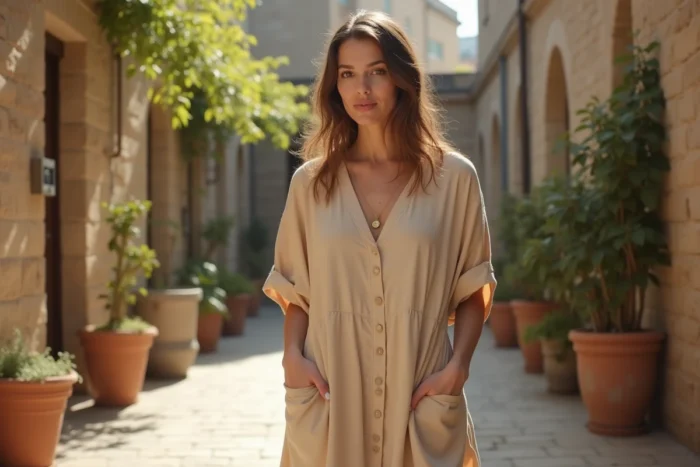
Specialized platforms like Looknbe recommend buying a garment only if you plan to wear it at least 30 times. A dress made of linen or certified organic cotton meets this criterion better than most pieces: it can be worn to the office with loafers, to the market with sandals, or in the evening with different accessories.
Linen, in particular, improves with each wash. Its fiber becomes softer without losing its shape. When comparing the average lifespan of a slim jean (whose elastane fibers degrade quickly) to that of a straight linen dress, the longevity gap clearly favors the dress.
Sustainable fashion guides for 2025-2026 emphasize the traceability of materials: GOTS labels for cotton, European Flax for linen. By targeting these certifications, a dress becomes a central investment in responsible fashion rather than an impulsive purchase. Several brands now offer women’s dresses on Caro Bleue Violette with this type of qualitative approach.
2. Midi dress: the most favorable versatility-to-bulk ratio
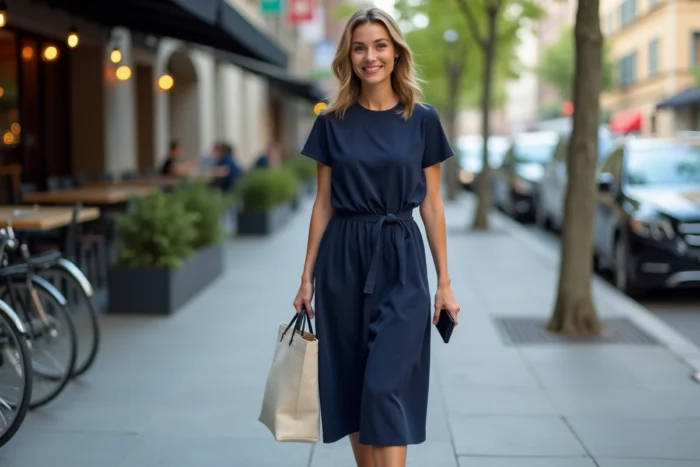
In a capsule wardrobe of 10 to 15 pieces, each garment must cover multiple situations. The midi dress (length between the knee and ankle) stands out because it works in every season: worn alone in summer, with opaque tights and a thin sweater in winter.
| Classic Combination | Number of Pieces | Equivalent Midi Dress | Number of Pieces |
|---|---|---|---|
| Pants + shirt + belt | 3 | Belted midi dress | 1 |
| Skirt + top + jacket | 3 | Midi dress + jacket | 2 |
| Jean + blouse + accessory | 3 | Midi dress + accessory | 2 |
This table illustrates a simple point: the midi dress replaces two to three pieces per outfit. The space saved in the wardrobe is real, and the time spent putting together a look each morning decreases.
3. Shirt dress: the office-to-weekend transition without a complete change

The shirt dress takes the codes of a garment already validated in the professional world (the shirt) and transposes them into a complete piece. Buttoned all the way up with a thin belt, it works in meetings. Open over jeans or leggings on Saturday, it shifts gears effortlessly.
What makes it particularly interesting is its morphological compatibility. Straight or slightly flared cuts suit very different body shapes. Specialists like Damart detail how to choose a dress when you want to highlight certain areas of the body: the shirt cut structures the silhouette without compressing it.
In terms of maintenance, poplin cotton or tencel can be washed at low temperatures and dry quickly. This is a practical advantage compared to blazers or suit pants, which often require dry cleaning.
4. Backless or asymmetrical dress: a single piece for special occasions

Many women accumulate outfits for occasional events: weddings, birthdays, formal dinners. The result: pieces worn once or twice, then forgotten. A well-chosen backless or asymmetrical dress covers most of these occasions.
The technical point to check: the quality of the fabric’s drape. A fluid material (crepe, matte satin, thick jersey) avoids the costume effect and allows the dress to be reused in various contexts. The trends for 2026 confirm the interest in these cuts that focus on a single strong detail rather than an accumulation of decorative elements.
- Backless crepe dress: suitable for summer evenings, worn with a mid-season jacket
- Asymmetrical one-shoulder dress: dressy enough for a civil wedding, yet understated for a professional dinner
- Minimalist draped dress: suitable for formal events without aging from season to season
Three dressy dresses replace five to seven occasional outfits in an average wardrobe. The financial savings and the space freed up justify the initial investment in a higher quality piece.
5. Knit or jersey dress: daily comfort without compromising on style

The jeans-and-t-shirt reflex dominates among many women more out of habit than choice. The knit or jersey dress offers a comparable level of comfort (stretch fabric, no constraints at the waist) while providing a more structured visual effect.
The difference is measured in actions: slipping on a dress takes a few seconds, compared to the time needed to match a top, a bottom, and check that the proportions work. In summer, the absence of seams at the waist and the airflow around the legs reduce thermal discomfort compared to pants.
- Organic cotton jersey: breathable, machine washable, retains its shape after many washes
- Ribbed knit: adds texture without rigidity, works in autumn with boots
- Tencel jersey: silky touch, natural moisture regulation, suitable for long days
Jersey absorbs the demands of daily life while maintaining a neat appearance. For denim enthusiasts seeking an alternative without leaving their comfort zone, this is the most natural entry point to dresses.
The capsule wardrobe is gaining ground, and the anti-fast fashion law increases the cost of impulsive purchases. In this context, each well-chosen dress – certified, versatile, durable – takes the place of several less thoughtful pieces. The calculation is made both in terms of the number of wears and the euros spent.