
A leaking faucet, a shelf to fix, a flat-pack furniture to assemble: these situations arise unexpectedly. The difference between a quick repair and a two-hour ordeal often lies in the tools available in the cupboard. Having the right DIY tools at home doesn’t require an extravagant budget or a garage filled from floor to ceiling. A well-chosen, compact selection covers the vast majority of common household tasks.
Cordless drill-driver 18 V: the first tool to buy
Have you ever tried to screw in thirty screws by hand while assembling furniture? Your wrist remembers it for a long time. The cordless drill-driver solves this problem and many others. It screws, unscrews, drills wood, plaster, and depending on the model, metal or hollow brick.
For versatile domestic use, aim for an 18 V drill-driver with a torque of at least 45 Nm. This power threshold allows you to drill hard wood and screw into beams without straining. Below this, the tool slips on slightly resistant materials.
A detail that changes everything: choose a model that comes with two batteries. While one is working, the other is charging. This avoids interruptions in the middle of a project. Among reliable references, you can find those detailed on the equipment page of Ben Le Bricoleur, which ranks models based on their value for money.
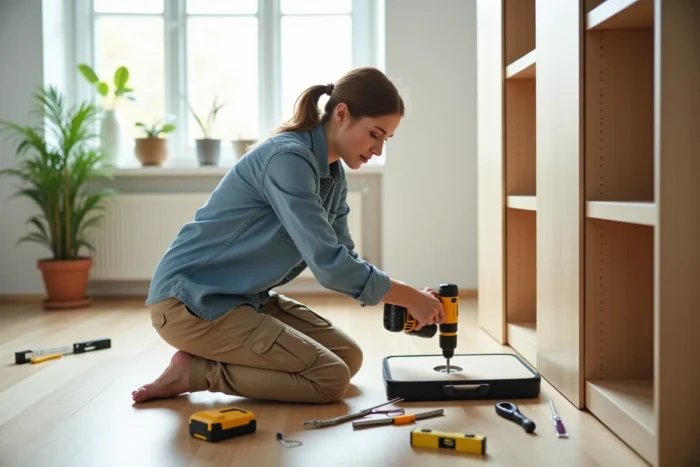
Starter hand tools kit: 8 references are enough
The temptation of a giant 100-piece set is strong. The problem is that half of the pieces remain unused and their quality leaves much to be desired. Recent guides converge towards a different approach: a reduced kit of 8 to 12 high-quality tools covers almost all household needs.
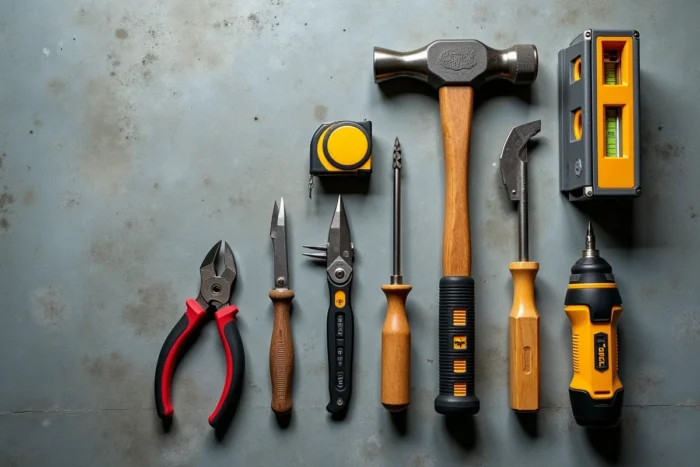
Here are the hand tools to prioritize:
- A medium-sized hammer with a claw, which allows both driving and removing nails without additional tools.
- A set of screwdrivers (flat and Phillips in two sizes each), or better, a screwdriver with interchangeable bits that replaces six screwdrivers by itself.
- A combination plier and a cutting plier, the duo that covers common plumbing, tightening, and wire cutting.
- A 5-meter tape measure and a spirit level, because a shelf placed crookedly is immediately noticeable and always ends up being annoying.
- A retractable blade cutter for opening, cutting, and adjusting.
The adjustable wrench, often forgotten
One rarely thinks of the adjustable wrench for a first purchase. Yet it replaces an entire set of flat wrenches when you only need to tighten a nut occasionally. A 250 mm model is sufficient for domestic plumbing fittings and tightening common bolts.
Measuring and marking: the real weak point of beginner DIYers
Drilling a hole in the wrong place, cutting a board too short by one centimeter: these mistakes almost always stem from a rushed measurement. A good tape measure and a reliable level prevent more problems than an expensive power tool.
The classic spirit level remains perfectly functional for hanging a frame or placing a shelf. For those planning more ambitious projects (laying tiles, marking lines over several meters), a laser level offers superior precision and comfort. The choice depends on the frequency of use.
A carpenter’s pencil and a metal ruler complete the marking kit. The carpenter’s pencil has a flat lead that draws a visible line on raw wood without rolling off the workbench, two advantages absent from a regular pencil.
Sawing and cutting: choose according to the material
Why does this choice deserve reflection? Because an unsuitable saw damages the material and tires you unnecessarily. For wood, a universal tooth hand saw cuts battens, boards, and melamine panels. Count on a blade of about 500 mm for a good compromise between precision and cutting speed.
For frequent cuts or in thicker wood, an electric jigsaw takes over. It also allows for curved cuts, which no hand saw does neatly. This is a secondary purchase to consider once projects multiply.
Cutting non-wood materials
To cut a copper or PVC pipe, a dedicated pipe cutter does a clean job in seconds. A hacksaw remains useful for metal profiles, but it rarely comes out of the drawer in purely domestic use.
Personal protective equipment: what the toolbox should also contain
There is much talk about tools, rarely about safety. A few simple pieces of equipment limit the most common accidents:
- Protective goggles, to be worn systematically for drilling and cutting. A dust particle from concrete or a wood splinter in the eye turns a Saturday DIY into a trip to the emergency room.
- Appropriate work gloves, neither too thick (loss of dexterity) nor too thin (no protection).
- Earplugs for prolonged use of the jigsaw or hammer drill, whose noise level quickly exceeds the comfort threshold.
Protective gear costs almost nothing and prevents the most common domestic injuries. Storing them directly in the toolbox ensures they will be on hand when needed.
Starting budget and gradual purchasing logic
A complete set of hand tools combined with a decent drill-driver represents a starting budget between 150 and 250 euros. This amount is sufficient for common repairs, furniture assembly, and small renovations.
The classic mistake is to buy everything at once, including specialized tools that may never be needed. A more cost-effective approach: start with the basic kit, then add a tool as projects arise. The jigsaw comes when a real cutting need arises. The sander arrives with the first piece of furniture to renovate.
Each added tool then addresses a concrete problem, not a theoretical list. It is this progressive logic that distinguishes a truly useful toolbox from a drawer filled with never-unpacked items.