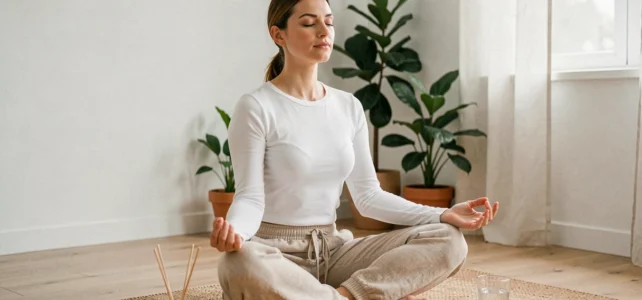
You come home from work, sit on the couch, and the evening passes without you taking a moment for yourself. The next day, the same scenario. Adopting a daily wellness routine doesn’t require you to overhaul your schedule. It’s more about embedding a few short, regular habits into the gaps of your day.
Micro-wellness rituals: why short breaks work better
Wellness trends in France describe a clear shift towards fragmented practices. We now talk about movement snacks: a few minutes of stretching between two sitting periods, a brisk walk after lunch, a bit of joint mobility in front of the coffee machine.
This logic of regularity without exhaustion replaces large sports programs or intensive meditation. Three deep breaths before a meeting, a moment of screen-free silence in the evening, a back stretch after an hour of working on the computer: these actions take less than five minutes each.
Exploring wellness with Bee Healthy helps to better understand how these small rituals fit into a broader health approach.
The idea is not to add a burden to your day. It’s the opposite: a well-placed micro-ritual reduces mental load instead of increasing it. You don’t need to find an hour of free time. You need to identify three slots of two minutes.

Morning and evening routines: two anchors that structure the day
Have you ever noticed that chaotic mornings contaminate the rest of the day? The morning sets the tempo. The evening prepares for recovery. These are the two moments when a wellness routine has the most impact.
In the morning: start before the screen
The most common reflex upon waking is to check your phone. The problem is that the brain immediately switches to reactive mode. It processes notifications, messages, requests. It chooses nothing.
An effective morning ritual starts before the first screen. Drink a large glass of water, do a few shoulder and neck movements, breathe calmly for a minute. These three actions take less time than checking your messages.
In the evening: prepare for sleep in advance
Sleep doesn’t turn on like a switch. The body needs a transition signal. Effective practices are simple: lower screen brightness an hour before bedtime, write down what needs to be done the next day (to clear the mind), and engage in a calming activity, like reading or slow breathing exercises.
The small evening ritual affects sleep quality, not just its duration. Sleeping for seven restless hours is not as beneficial as six hours of deep sleep.
Stress management at work: integrating wellness into productive hours
Most wellness routines focus on the morning and evening. The problem is that stress accumulates in between, during work hours. This is where micro-breaks make all the difference.
- Every 90 minutes or so, look away from the screen, stand up, and walk a few steps. This is not procrastination; it’s cognitive recovery.
- Before a task that requires concentration, take three slow breaths through the nose, extending the exhale. This action activates the parasympathetic nervous system and reduces physical tension.
- During lunch break, eat without screens for at least ten minutes. Chew slowly, savor the textures and flavors. This simple slowdown improves digestion and cuts off the flow of information.
These habits require no equipment, no apps, no subscriptions. They are based on one principle: the body sends signals of fatigue long before exhaustion. Systematically ignoring them eventually degrades concentration, sleep, and mood.

Physical activity and hydration: two often underestimated pillars
Adopting a wellness routine without mentioning the body would be incomplete. Two elements appear in all serious approaches: moving regularly and drinking enough water.
Moving doesn’t mean running a half-marathon. A daily walk of twenty to thirty minutes is enough to produce measurable effects on stress and sleep quality. Gentle yoga, easy swimming, biking for short trips: physical activity works when it integrates into everyday life, not when it requires logistical effort.
For water, the guideline is simple: drink before you feel thirsty, in small amounts throughout the day. Keeping a visible bottle on your desk or in your bag often suffices to naturally increase consumption.
Setting realistic goals for long-term adherence
The classic mistake is to want to change everything at once. New diet, daily exercise, meditation, journaling, dietary supplements. After two weeks, motivation collapses.
The method that lasts over time is gradual:
- Choose a single habit and practice it for two weeks before adding another.
- Associate the new habit with an existing action (for example, breathe three times after brushing your teeth).
- Accept the off days. Missing a day doesn’t destroy a routine. Resuming it the next day strengthens it.
A wellness routine lasts because it is modest, not because it is ambitious. Three small daily actions are better than a complete program abandoned after a month.
Mental health became a national priority in 2026, and this recognition is accompanied by a massive spread of dedicated digital tools: breathing apps, mood tracking, guided journaling. These resources can complement a personal routine, as long as they don’t become an additional source of screen time. The best tool is the one you actually use, even if it’s just a simple notebook on your nightstand.