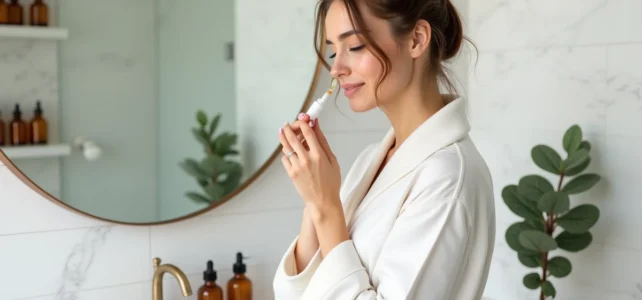
The average number of hygiene-beauty occasions per week has significantly declined over the past decade. This decline illustrates a lasting change in habits: consumers are reducing unnecessary gestures and focusing their routines on high-value steps. Understanding this movement allows for a reorientation of beauty routines towards more targeted, effective, and time-efficient care choices.
Skin prep for makeup: the technique that changes product longevity
Skin prep is no longer just a simple cleansing followed by a moisturizer. It has now become a standalone step, designed to condition the skin before makeup application. The hashtag #skinprepformakeup has over 122 million views on TikTok, indicating that this approach has moved beyond professional makeup artists to reach a broad audience.
The principle is based on three complementary mechanisms. First, a targeted cleansing that removes the oxidized lipid film from the night without stripping the skin barrier. Next, hydration through thin layers (light layering) with fast-absorbing aqueous textures. Finally, a primer suited to the type of foundation used, not just the skin type alone.
A common mistake is choosing the primer based on skin type (mattifying for oily skin, hydrating for dry skin) without considering the foundation. In reality, the primer must be compatible with the foundation formulation: a silicone base under a water-based foundation causes pilling and reduces wear to just a few hours.
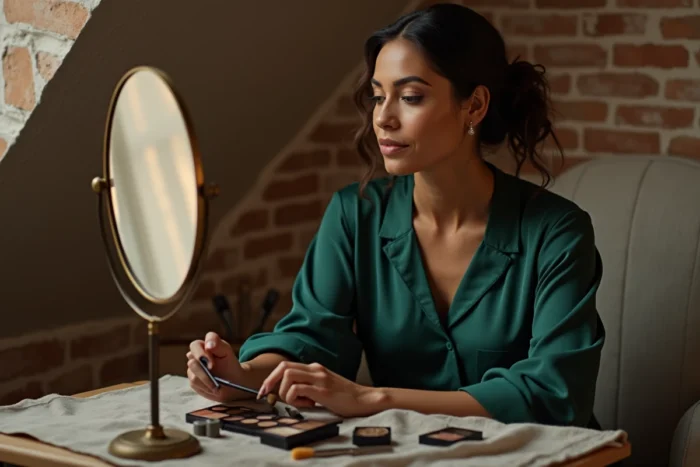
To delve deeper into the products and techniques suited for each step, the beauty site Autour de Chloé details selections of care categorized by use, making it easier to choose between textures and actives based on your makeup wear goals.
Order of textures in skin prep
- Toner or hydrating essence applied on damp skin, patted (not rubbed), to create a water reservoir on the surface
- Low molecular weight hyaluronic acid serum, which smooths micro-reliefs and improves makeup adherence
- Light moisturizer or gel-cream, allowed to absorb for two to three minutes before the primer, to avoid any slip effect
- Primer formulated in the same base (aqueous or silicone) as the chosen foundation
Clean beauty: beyond marketing talk, a measurable demand
Clean beauty has long been perceived as a sales argument without precise regulatory content. Recent data shows otherwise. Accio reports a spike in purchase intent in November 2025 for clean skincare and makeup, suggesting an acceleration of actual demand, not just declared intent.
This movement is changing the selection criteria for a daily routine. The informed reader no longer seeks only the absence of parabens or silicones. They demand a short INCI list, actives with documented efficacy, and packaging that reduces over-packaging.
We recommend distinguishing three levels of reading on a product labeled “clean”:
- The composition: check the position of the claimed actives in the INCI list (a star active placed at the end of the list is present in negligible amounts)
- The certification: labels like Cosmos Organic or Ecocert provide a verifiable framework, unlike the simple mention “natural” which has no regulatory value
- The manufacturer’s transparency: publication of active percentages, accessible efficacy tests, traceability of plant ingredients
A cream stating “97% natural origin ingredients” may contain water for the bulk of that percentage. The natural origin percentage does not inform about the concentration of active ingredients. This is the most common trap in the clean segment.
Face routine and hydration: simplify without sacrificing effectiveness
The trend towards simplification does not mean randomly eliminating steps. It involves prioritizing actions based on their actual impact on skin quality.
Cleansing remains non-negotiable, morning and night. However, applying five stacked serums is more about psychological ritual than measurable skincare. Two well-chosen actives penetrate better than a layering of five competing formulas.
For combination to oily skin, a combination of niacinamide (sebum regulation) and hyaluronic acid (non-occlusive hydration) covers most daily needs. For dry skin, a ceramide-based serum paired with a rich fatty acid cream is sufficient to restore the lipid barrier without multiplying layers.
Sun protection in the daily routine
Sun protection is the gesture with the highest effort-benefit ratio in terms of preventing skin aging. However, one technical parameter conditions all its effectiveness: the amount applied determines the actual protection index.
Applying half the recommended dose does not halve the protection; it reduces it exponentially. The two-finger rule (two lines of product on the index and middle fingers) for the face and neck remains the most reliable method to achieve the lab-tested dose.
Makeup and hybrid care: multifunctional products and cream texture
Hybrid products (tinted skincare, pigmented lip balm, cream blush with SPF) directly respond to the contraction of routines. They reduce the number of steps without compromising visual results.
The main selection criterion is texture. Cream formulas blend with the fingers in seconds and merge with the skin prepared by skin prep. Compact powders, which take longer to apply and are less suited for dehydrated skin, are losing ground.
For lips, tinted balms enriched with vegetable oils (jojoba, argan) advantageously replace the duo of hydrating balm followed by lipstick. They provide color, hydration, and comfort in one gesture, aligning with the logic of a streamlined yet complete beauty routine.
The Chinese market confirms this trend: according to VVR International, consumers now place more weight on demonstrable efficacy and value for money than on brand recognition. This demand pushes manufacturers to formulate multifunctional products where each active is justified, not just displayed.
Properly dosed sun protection remains the gesture with the best yield, followed by hydration suited to the season and skin type. The rest adjusts according to time constraints and texture preferences.