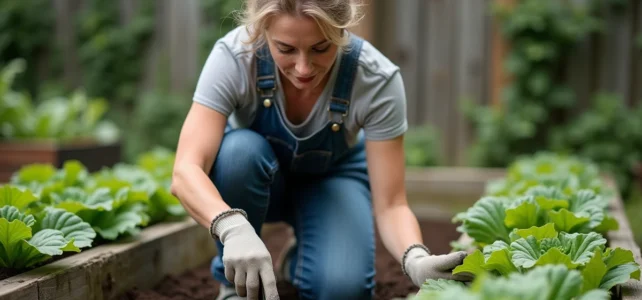
What difference in results separates a bio vegetable garden worked with a grelinette from a traditionally dug garden? The question deserves to be asked from the perspective of the soil itself: structure, biological activity, medium-term yield. The available data allows for a comparison of these two approaches across several concrete criteria, from residual compaction to dependence on commercial substrates.
Grelinette vs. Spade: What the Soil Really Endures
The difference between aerating and turning the soil is not just a gesture. It conditions microbial life, water circulation, and the soil’s ability to nourish plants without external inputs.
| Criterion | Traditional Digging (spade or tiller) | Grelinette Work |
|---|---|---|
| Action on soil layers | Inversion of horizons, mixing of strata | Loosening without inversion |
| Impact on microbial life | Significant disturbance, partial destruction of fungal networks | Preservation of soil fauna and flora |
| Residual compaction after use | Frequent plowing pan at depth | Progressive decompaction, no pan |
| Physical effort (back, shoulders) | Concentrated load on the lower back | Lever movement, effort distributed across arms and body weight |
| Dependence on potting soils and amendments | High (soil depleted with each turning) | Reduced if combined with compost and mulching |
The inversion of soil layers through digging exposes anaerobic microorganisms to the air and buries those living on the surface. This double biological shock depletes the soil season after season. The grelinette, by lifting the soil without turning it, keeps each layer in its place.
A rarely measured point: dependence on purchased substrates. The French potting soil market is experiencing increasing supply tensions. A living soil, regularly aerated with a grelinette and nourished by homemade compost, greatly reduces the need to buy potting soil. Over several seasons, this autonomy changes the economic logic of the vegetable garden.
To delve deeper into the choice of tool and its variations (number of tines, working width, handle materials), the detailed sheets on grelinette-warrior.com allow for model comparisons based on soil type.
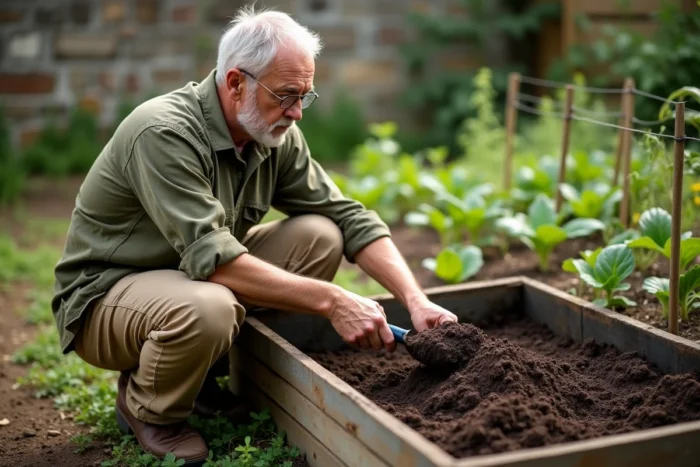
Living Soil in the Bio Vegetable Garden: Practices that Extend the Effect of the Grelinette
Using the grelinette is not enough if the soil is left bare and exposed to the elements in the days that follow. Systematic mulching locks in the benefits of soil work by limiting evaporation, protecting fauna, and preventing crusting.
Mulching and Compost: The Duo that Replaces Inputs
The combination of grelinette, mulching, and compost forms a virtuous cycle. Compost nourishes soil life, mulching protects it, and the grelinette reinitiates aeration when the soil naturally compacts from rain.
- Mulch with local materials (dried grass clippings, fallen leaves, chipped branches) as soon as the soil is aerated, with a sufficient thickness to block light at the level of weeds.
- Add mature compost on the surface before mulching, without burying it: earthworms and microorganisms will integrate it into the lower layers.
- Limit foot traffic on the growing beds to avoid recompacting the soil between grelinette sessions.
This triptych also limits the pressure from unwanted weeds. A permanently covered soil leaves little room for spontaneous germination, which significantly reduces weeding time.
When and How to Use the Grelinette
The grelinette should ideally be used when the soil is neither waterlogged nor as dry as concrete. Slightly moist soil decompacts easily: the tines penetrate without forcing, and clods break apart on their own when pulling the handles back.
The action consists of three steps. First, push the tines vertically using body weight. Next, pull the handles towards you to lift the clod. Finally, rock laterally to crumble the soil without turning it. This lever movement spares the back, unlike digging, which strains the spine with each scoop.
Natural Crop Protection: Reducing Treatments Through Soil
A biologically active soil does not just nourish plants. It also participates in their defense. Mycorrhizal networks, preserved by the absence of turning, facilitate nutrient absorption and strengthen plants’ resistance to stress.
Organic regulations increasingly emphasize the preservation of living soil as a lever for reducing inputs. In practice, this translates into alternatives to chemical treatments that rely on soil and garden biodiversity.
- Plant extracts and decoctions (nettle, horsetail, comfrey) complement the action of a healthy soil by providing trace elements and stimulating natural defenses.
- Crop associations (tomatoes-basil, carrots-leeks) disrupt pests by confusing olfactory signals.
- Crop rotation, facilitated by well-defined and aerated vegetable beds with the grelinette, breaks the cycle of soil-borne diseases.
These methods work even better when the soil has not been disturbed by turning. A non-turned soil hosts more natural predators (ground beetles, rove beetles, earthworms) that regulate pest populations without external intervention.
Choosing Your Grelinette According to Your Soil and Garden Size
The number of tines determines the working width and the effort required. However, a five-tine model, which is wider, is suitable for already worked soils and large beds, while a three-tine model works better in heavy or clay soils where resistance is high.
The quality of the handles is as important as that of the tines. Hardwood handles (ash, beech) absorb vibrations better than metal handles. The length of the handles should correspond to the user’s height so that the lever movement remains natural and without lumbar strain.
The bio vegetable garden derives most of its fertility from the soil itself. The grelinette is not just a seasonal preparation tool: it conditions the structure in which roots, microorganisms, and earthworms coexist. Combined with permanent mulching and compost, it transforms the soil into an autonomous substrate that gains fertility year after year instead of depleting.