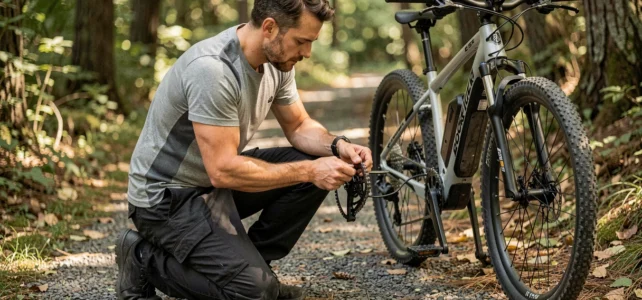
The Rockrider E-ST 100, an electric mountain bike sold by Decathlon, equips a large number of cyclists in France. Its entry-level motorization and simplified electrical system make it accessible, but this simplicity has its downsides. Certain failures recur with a regularity that the usual manuals and tutorials do not always detail, particularly the cut-offs related to the thermal management of the motor and controller.
Thermal Cut-off of the Motor on the Rockrider E-ST 100: A Under-Documented Issue
Since 2024, field reports have indicated an increase in cases where assistance reduces or cuts off after a few kilometers uphill, or simply due to high heat. The phenomenon does not correspond to a clear failure: assistance works normally when cold, then power gradually decreases under load, before returning to normal after cooling down.
This behavior stems from the internal protections of the controller and motor. When the temperature exceeds a predefined threshold, the system enters protection mode. In recreational mountain biking with prolonged slopes, a rocky path that forces pedaling, or a summer outing, this threshold is reached much faster than during a ride on flat roads.
Before suspecting a hardware defect, it is essential to identify this pattern: normal assistance when cold, gradual cut-off under load, return after a pause. If this scenario repeats, the failure is probably not a failure at all, but a triggering of the thermal protection. Reducing the level of assistance on long climbs, or taking a break for a few minutes in a shaded area, usually suffices to regain power.
To go further and repair a failure on the Rockrider E-ST 100 methodically, it remains useful to distinguish this thermal cut-off from true electrical failures.
Error Codes on the E-Bike Screen: Photograph Before Restarting
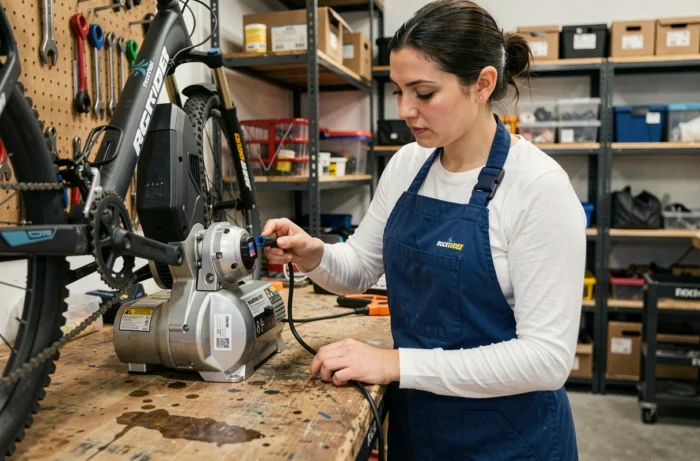
The most common reflex in response to an abnormal display on the E-ST 100 screen is to turn off and then turn on the bike. This action often erases the displayed error code, making diagnosis much more difficult, whether in the workshop or for personal research.
Recent technical guides on e-bikes and electric devices now recommend systematically photographing the screen before any restart. The displayed code (often a digit or letter followed by a number) identifies the source of the problem: pedaling sensor, controller overheating, communication failure with the battery, abnormal voltage.
Without this information, a technician will have to reproduce the failure or proceed by elimination, which prolongs the intervention and the cost. With the photo, the diagnosis saves considerable time. This habit applies to all intermittent failures, those that appear when hot, uphill, or after passing through a puddle.
Connectors and Wiring: The Simplest Source of Failures to Check
On the E-ST 100, several connectors link the battery to the controller, the controller to the motor, and the pedaling sensor to the whole system. These connectors are exposed to water splashes, mud, and vibrations. A slightly loose or oxidized connector can cause misleading symptoms:
- Assistance cuts off randomly, without a visible error code, then returns by itself after a bump or a stop
- The screen briefly goes off while riding, as if the battery is disconnecting, while it is indeed properly connected
- Only one level of assistance works, the others seem inactive or identical in power
Before any further intervention, unplugging and then replugging each accessible connector helps eliminate a bad contact. Visually inspect the pins for green oxidation or dirt deposits. Cleaning with electronic contact cleaner, followed by complete drying before replugging, resolves a significant portion of these intermittent failures.
Tire Pressure and Range: A Direct Link Often Overlooked
The Decathlon manual recommends inflating the tires of the E-ST 100 between 1.0 and 1.8 bar on the original tube setup. This wide range allows for some leeway, but too low a pressure puts more strain on the motor and significantly reduces the battery’s range.
On an electric mountain bike, the wheels bear both the weight of the bike (heavier than a traditional mountain bike) and the torque of the motor. An under-inflated tire increases rolling resistance, which forces the assistance system to provide more energy to maintain the same speed. The result: a battery that drains faster, and sometimes a feeling of power loss that has nothing to do with an electrical problem.
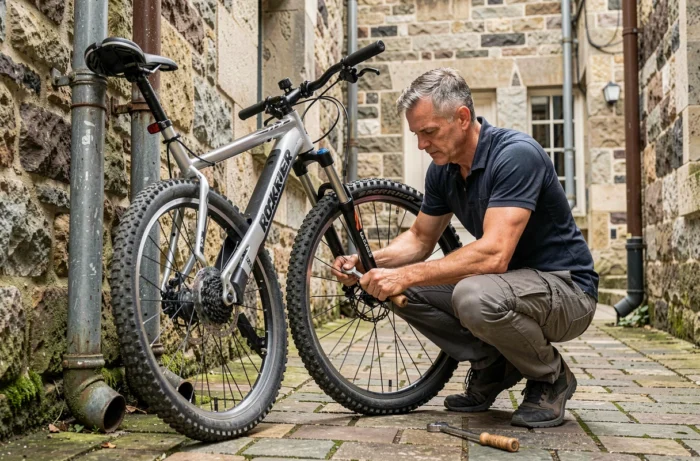
Checking the pressure before each outing, with a reliable gauge, avoids this type of false alert. For technical paths where grip is paramount, going down to 1.2 bar remains reasonable. For mixed road-path journeys, increasing to 1.6 to 1.8 bar improves efficiency and preserves the battery.
Decathlon Ride App and Firmware Updates
The E-ST 100 connects via Bluetooth to the Decathlon Ride app. Beyond outing statistics, this connection allows for firmware updates of the electrical components (controller, screen, sensors). These updates sometimes fix software bugs that cause abnormal assistance behavior.
A bike whose firmware has never been updated since purchase may exhibit symptoms that resemble hardware failures. Assistance that no longer responds to a mode change, a frozen display, or a pedaling sensor that seems delayed in its response can all be due to a software fix that is already available.
What the App Will Not Solve
Field reports vary on this point: some users report that updates have resolved persistent issues, while others have seen no improvement. The app does not replace a mechanical diagnosis. A battery with aging cells, a motor with seized bearings, or brakes that constantly rub against the disc require physical intervention.
- Regularly check the actual charge status of the battery (not just the displayed percentage, but the behavior at the end of the charge)
- Listen for abnormal noises from the motor at low speed, which may indicate a worn bearing
- Check the wear of the brake pads, whose residual friction increases the load on the motor
The Rockrider E-ST 100 remains a bike designed to be maintained by its owner for routine operations. The majority of failures reported on dedicated forums and groups stem from a dirty connector, inappropriate tire pressure, or poorly identified thermal protection. Knowing how to recognize these simple causes before heading to the workshop saves time and money.