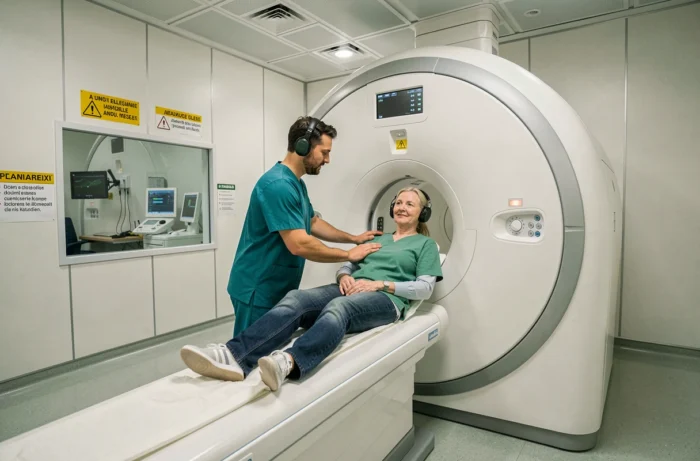
A patient lying in an MRI tunnel hears a regular humming sound. Within minutes, hundreds of images of their organs are reconstructed on a screen. Behind this apparent routine, the radiology centers in Aix-en-Provence are undergoing a rapid transformation, where new equipment coexists with significant pressures on recruitment and the organization of care.
Photon Counting Scanner: What This Technology Changes for Patients in Aix
Most scanners operate on an old principle: an X-ray beam passes through the body, a detector measures the residual intensity, and software reconstructs a grayscale image. The result is useful, but it mixes information that the radiologist must then interpret visually.
The photon counting scanner works differently. Instead of measuring an overall intensity, each X photon is detected individually and classified according to its energy. This allows for the distinction of tissues that are very close in density, such as a small pulmonary nodule and a nearby blood vessel.
The Aix-Pertuis Intercommunal Hospital Center (CHIAP) is the first non-university hospital center in France to equip itself with this technology. For patients, two direct benefits emerge: a reduction in the dose of radiation received and shorter appointment wait times, as the examination becomes faster. A broader overview of the local offering can be read on the Les Milles radiology center on Smart Mag, which details the evolution of the Aix health hub.
Artificial Intelligence in Radiology: Diagnostic Assistance, Not Replacement of the Radiologist
Have you noticed that some imaging reports now mention “AI assistance”? Several practices in the Aix-en-Provence region are integrating artificial intelligence software into their daily workflows. The principle is simple to understand.
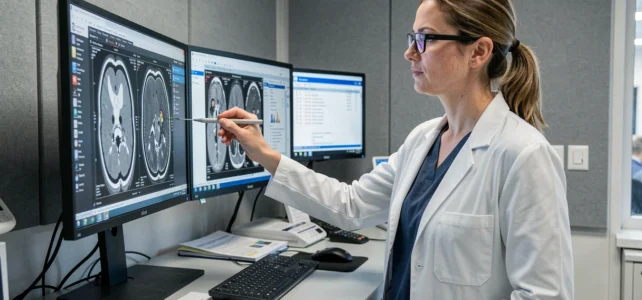
The radiologist uploads the images to a workstation. An algorithm analyzes them in a few seconds and flags suspicious areas: a micro-calcification on a mammogram, a density anomaly on a chest scan. The AI spots, the radiologist decides. The software does not make a diagnosis. It acts as an automated second pair of eyes that reduces the risk of missing a subtle lesion.
Screening and Follow-Up: The Cases Where AI Provides the Most
The contribution focuses on high-volume screening exams, such as mammography. When a radiologist reads several dozen exams in a row, visual fatigue increases the risk of error. The algorithm applies the same criteria to each image without variation in concentration.
In contrast, for complex exams (brain MRI with injection, shoulder arthro-scan), interpretation remains highly dependent on the clinical context. AI plays a more limited role here, and the dialogue between the radiologist and the referring physician remains key to a reliable diagnosis.
Shortage of Radiologists and Technicians: The Main Challenge for Aix Centers
A photon counting scanner or AI software is useless without qualified personnel to operate them. However, the Aix-Marseille region is facing significant pressure on recruitment in medical imaging.
Job postings published in 2026 for positions of radiology technicians and radiologists in Bouches-du-Rhône are numerous, both permanent and temporary. This situation reflects a national imbalance, but it takes on a particular dimension in Aix, where the demand for care is high.
Why the Pressure is So Pronounced Locally
- The cost of living in Aix-en-Provence hinders the settling of young healthcare professionals, whose initial salaries do not compensate for the high rents in the city center and nearby areas.
- The proliferation of modern technical platforms (1.5T and 3T MRIs, recent scanners) requires technicians trained on this equipment, while the pool of graduates remains limited each year.
- Private practices are under economic pressure documented by the profession itself: the financial viability of certain radiology procedures is deteriorating, making private practice less attractive for young radiologists.
Multi-Site Networks and Governance of Imaging Centers
In the face of these constraints, a fundamental trend is emerging: structuring into networks. The holding company France Imageries Territoires, for example, has recently expanded its corporate purpose to include taking stakes in imaging structures and supporting diagnostic investment projects.
Why is this model of interest to Aix centers? A multi-site network allows for the pooling of expensive equipment, smoothing staff schedules across multiple practices, and collectively negotiating machine maintenance. An isolated radiologist does not have the same negotiating power as a network of twenty centers.
Territorial coordinators are now in place in some regions to operationally manage these centers. This professionalization of governance could be implemented in the Aix-Marseille area, where several structures coexist without formal coordination.
What This Changes for the Patient
From the patient’s perspective, a well-organized network means faster access to the appropriate examination. If an MRI at one center is fully booked, the network can direct to another site with an available slot, without the patient having to restart their process from scratch.
However, the quality of service relies on one prerequisite: a shared patient file between the network’s sites, with images securely accessible by all concerned radiologists. Without this interoperability, pooling remains a wishful thinking.
Medical imaging in Aix stands at the crossroads of two opposing movements. On one side, concrete technological advancements (photon counting, AI assistance) improve the accuracy and speed of exams. On the other side, the shortage of professionals and the economic fragility of private radiology threaten access to care. The ability of centers to attract practitioners and to structure themselves into networks will determine, in the coming years, whether the residents of the region will truly benefit from these technical advancements.