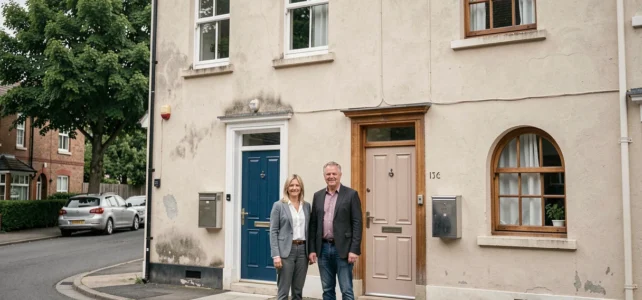
A vertical co-ownership of two lots can exist without any common areas being listed in the co-ownership regulations. This configuration, more common than one might think in small buildings divided into two stacked apartments, raises specific legal questions regarding governance, works, and the distribution of charges. The law of July 10, 1965, continues to apply, but the day-to-day functioning differs radically from that of a classic co-ownership.
Absence of common areas: what this means legally
In a standard vertical co-ownership, the staircase, the roof, the structural work, or the vertical pipes are common areas. When the co-ownership regulations assign the entirety of the building into private lots without identifying common areas, each co-owner is the exclusive owner of their lot, including the structural elements that compose it.
This situation does not eliminate the status of co-ownership. The regime of the 1965 law applies as soon as a building is divided into lots comprising a private part and a share of common areas, even if this share is effectively reduced to nothing. Jurisprudence has confirmed that a building subject to the status of co-ownership remains so as long as the co-owners have not voted to exit the regime.
In practice, one of the co-owners may own the ground floor with the floor slab, while the other owns the upper floor with the roof. The intermediate floor, the facade wall, or the passing networks then become gray areas if the regulations do not mention them. Precisely qualifying each element in the co-ownership regulations avoids most disputes.
When looking at a vertical co-ownership of 2 lots without common areas, the drafting of the regulations is the first document to examine, as it determines the boundary between the two lots.
Specific regime for co-ownerships with two co-owners

Ordinance No. 2019-1101 of October 30, 2019, created a regime specific to co-ownerships whose lots are divided between two co-owners, codified in Articles 41-13 to 41-23 of the 1965 law. This regime is triggered not by the number of lots but by the number of co-owners.
The general assembly is not mandatory in this context. Decisions can be made by written agreement between the two co-owners, simplifying governance. When an agreement is impossible, either party can bring the matter to the judicial court to obtain permission to carry out works or contest a decision.
Decree No. 2025-1292 of December 22, 2025, introduced the possibility of convening a general assembly by email, which modifies the formalities applicable to very small co-ownerships. For two co-owners, this allows for the rapid formalization of a disagreement or a vote without going through registered mail.
- Routine decisions (maintenance, minor repairs) are made by written agreement between the two co-owners, without convening a general assembly.
- Decisions affecting the structure or purpose of the building require unanimity, which amounts to obtaining the agreement of the other co-owner.
- In the event of a persistent deadlock, the judicial court can be approached to appoint a provisional administrator or authorize urgent works.
Insulation works in a vertical co-ownership of 2 lots: a common trap
The issue of works is the main point of friction in this configuration. When the roof is attached to the lot of the upper floor co-owner and the lower floor to the ground floor lot, each owner can theoretically decide alone to insulate the element that belongs to them.
The decree of December 22, 2025, clarified the individual right to insulate the roof or the floor above their lot, even if the works affect elements that could be considered common. This possibility is framed by two conditions: the works must not be included in an already adopted multi-year works plan (PPT), and they must not compromise the building’s structural integrity.
In a building with two lots without common areas, the PPT is generally not established, which opens the door to individual initiatives. However, the co-owner of the top floor who wishes to insulate their roof from the outside alters the appearance of the facade, which can affect the other lot. Without identified common areas, the co-ownership regulations remain the only reference to resolve disputes.
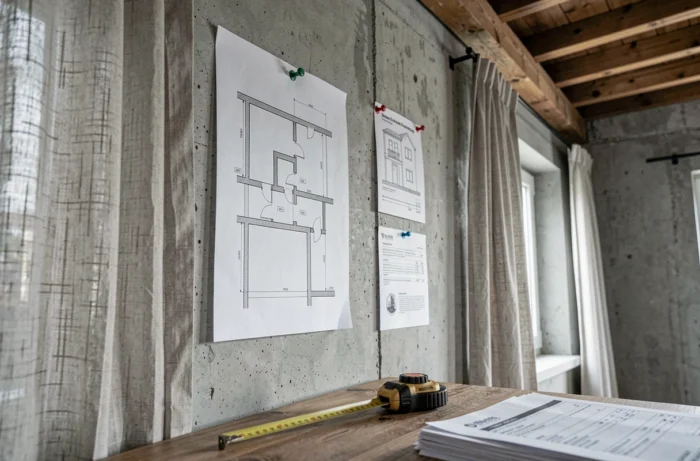
Property manager and current management: is a property manager needed in a co-ownership of 2 lots?
Small co-ownerships of five lots or fewer can adopt simplified management. With two co-owners, the appointment of a professional property manager is not a practical obligation, even if the law requires that a property manager be appointed.
One of the two co-owners can serve as a volunteer property manager. This solution works as long as relations remain cordial. When a conflict arises, the volunteer property manager finds themselves both judge and party, complicating the resolution of disputes.
The management of charges in a co-ownership without common areas often limits itself to the building’s insurance costs and, sometimes, to the maintenance of passing networks. If the regulations do not provide for any common charges, each co-owner is solely responsible for the maintenance of their lot. This autonomy can cause problems when a lack of maintenance on one lot causes damage to the other, for example, a leak from the roof into the apartment below.
- Check that the co-ownership regulations explicitly mention who maintains the intermediate floor, the rainwater downpipes, and the common networks.
- Provide for a clause on the distribution of multi-risk building insurance costs, even in the absence of common areas.
- Anticipate conflict resolution modalities (mediation, court referral) directly in the regulations.
The absence of common areas does not exempt the holding of a national registration register, which gradually integrates new technical data on co-ownerships. Even a co-ownership of two lots must be registered there.
The configuration of a vertical co-ownership of two lots without common areas relies entirely on the quality of the co-ownership regulations. A lack of clarity in the regulations turns every decision, from replacing a gutter to insulating the roof, into a potential source of dispute between two co-owners who must coexist in the same building.