
We drive in Spain, we return to France, and a few weeks later a letter or a text message demands payment of a fine from the DGT (Dirección General de Tráfico). The reflex is to pay quickly to avoid an increase. This is exactly what scams imitating DGT fines aim for: to reproduce the urgency of an official notice to extract bank details or a transfer.
Official channels for notifying DGT fines for a foreign driver
The DGT uses three channels to notify a sanction, and no others. Postal mail remains the main channel for non-resident drivers: the fine arrives at the address associated with the vehicle, often via an intermediary (rental company, toll company, or collection agency mandated by the country of residence).
The second channel is the Dirección Electrónica Vial (DEV), an official electronic mailbox. Registration there is voluntary for individuals, mandatory for legal entities. If registered, the notification goes directly into this mailbox, with legal value.
The third channel, used only when the first two fail, goes through official editorial boards (TEU, TESTRA, or BOE). Public notifications can be consulted there, but this case mainly concerns Spanish residents who cannot be found at their address.
Receiving an official DGT fine notice in French therefore implies a postal sending or a DEV notification, never a simple SMS containing a payment link.

DGT SMS and emails: what the DGT actually sends
The DGT can send an SMS or an email, but only to indicate that a notification is waiting in the DEV. The content of the sanction never appears in the SMS itself. No amount, no details of the offense, no link to a payment page.
A message that directly displays an amount to be paid, a QR code, or a “Pagar ahora” button is fraudulent. Smishing campaigns imitating the DGT are multiplying: they replicate the official logo, use similar URLs (dgt-multas.es, dgt-pagos.com), and create a false urgency with a deadline of a few hours.
Quick checks on a suspicious SMS or email
- The sender asks for bank details to be entered in the message or via an external link: the DGT never does this by SMS or email
- The URL does not match the official domain sede.dgt.gob.es: any other domain is suspicious, even if it contains the letters “dgt”
- The message is written in approximate French with unusual phrasing for a Spanish administration (which communicates in Castilian, or via translated forms on the DEV)
- A very short deadline (24 hours, 48 hours) is imposed for payment: the actual deadlines from the DGT are counted in weeks
Check a DGT fine online without going through a received link
If in doubt about the reality of a fine, the rule is simple: never click on the received link. You can access the source directly through three paths.
The first is the DEV, accessible from sede.dgt.gob.es with a digital certificate or the Cl@ve system. All pending notifications can be found there. The second is the miDGT app, the official app of the DGT, which centralizes licenses, points, and sanctions. The third is the phone number 060, the information standard of the Spanish administration, which allows you to verify the existence of a sanction.
For a French-speaking driver who is not very familiar with the Spanish administration, the miDGT app is probably the most accessible path: the interface offers relatively intuitive navigation, even though it remains in Spanish.
Fines received after renting a car in Spain
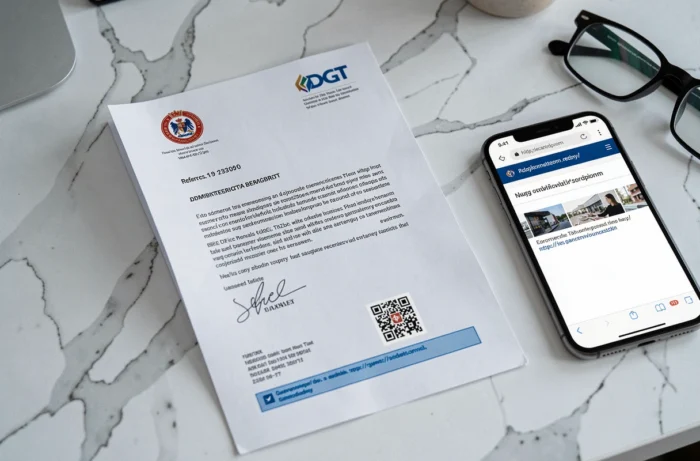
The most common case for a French tourist is the fine that arrives weeks after the end of the rental. The rental company forwards the driver’s details to the DGT, sometimes with a variable delay. The fine then passes through the rental company or a collection service, which complicates verification.
Here are some guidelines to distinguish a legitimate letter from a scam in this context:
- The letter mentions the license plate number of the rented vehicle, the exact rental dates, and a file number that can be verified with the rental company
- The collection service (such as European Parking Collection or Nivi Credit) has an identifiable website and reachable customer service, not just a simple payment page
- The amount corresponds to known scales of Spanish offenses (speeding, parking, ZBE) and not to an unusual round figure
If in doubt, contact the rental company directly with the contract number. Responses vary on this point; some rental companies respond quickly, while others take several weeks to confirm.
Differences between the French ANTAI fine scam and the DGT fine scam
Scams imitating ANTAI (the French side) and those imitating the DGT share the same phishing mechanics, but the warning signals differ on a key point. ANTAI sends its notices by postal mail or, if you opted for dematerialization, by email from an @antai.fr address. The DGT, on the other hand, notifies via the DEV or by mail, and its SMS notices never contain the details of the sanction.
An SMS that gives a specific amount to be paid is fraudulent, whether it claims to come from ANTAI or the DGT. Both administrations do not operate this way. The reflex remains the same: check on the official site (amendes.gouv.fr on the French side, sede.dgt.gob.es on the Spanish side) and never enter your bank details from a link received by message.
The last trap to be aware of concerns websites that offer to “check your DGT fine” for a service fee. These unofficial intermediaries charge for a service that can be done for free via the DEV or miDGT. A DGT fine can be consulted and paid without additional processing fees.